
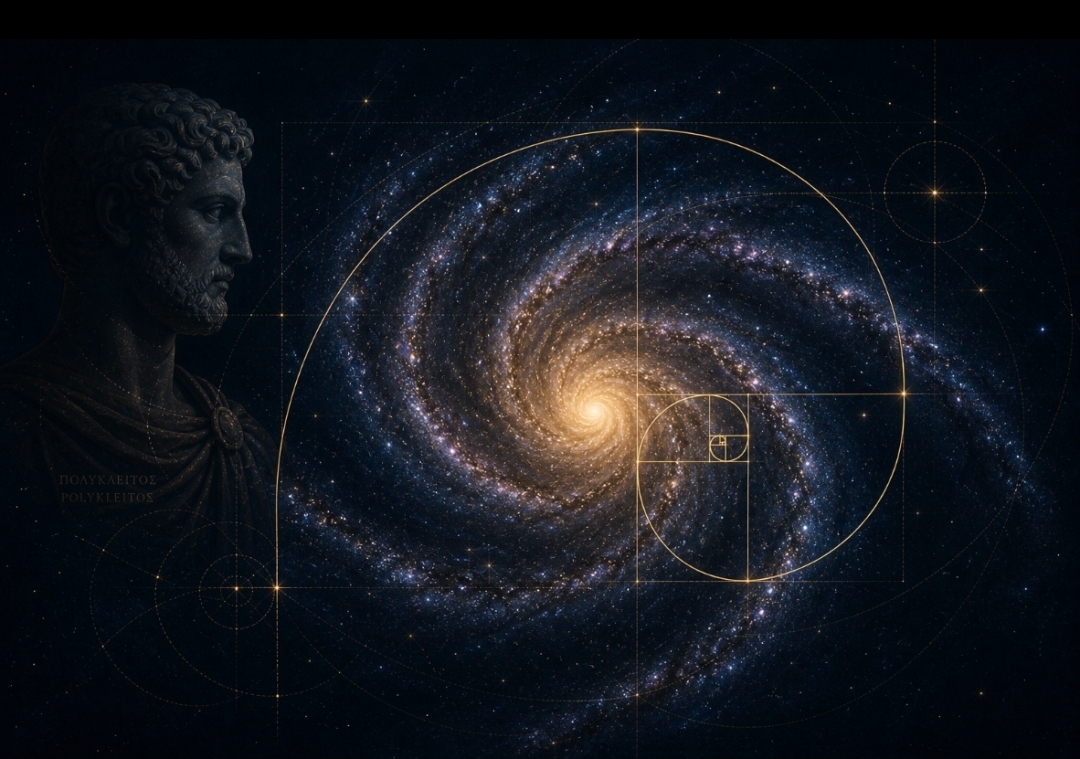
“Beauty may not emerge from ornament,
but from relationship.”
From Polykleitos to Musical Meaning
There are moments in history when art stops imitating the world — and begins to reveal its underlying structure.
In fifth-century Greece, the sculptor Polykleitos made such a discovery.
While others sought beauty through decoration, grandeur, or mythological narrative, he pursued something far more radical:
A system.
Not a style.
Not an emotion.
But a principle.
Polykleitos believed that beauty was not accidental.
It was not merely a matter of taste.
It could be approached through proportion, balance, and relationship.
The Hidden Order Behind Form
His lost treatise, known as the Canon, proposed one of the most influential ideas in the history of art:
Every part must exist in meaningful relationship to every other part.
A finger relates to the hand.
The hand relates to the arm.
The arm relates to the whole body.
Nothing stands alone.
Everything receives its meaning through proportion.
This principle, known as symmetria, was not simply visual balance.
It was structural coherence.
And in his famous statue, the Doryphoros, or Spear-Bearer, Polykleitos gave this idea physical form.
When Structure Begins to Breathe
The figure does not feel mechanical.
It does not feel calculated.
It feels alive.
This is the paradox at the heart of great art:
The more deeply structure is understood,
the more natural the result can appear.
Through the subtle balance of tension and release, weight and freedom, stability and motion, Polykleitos created a human figure that seems to pause between stillness and movement.
Mathematics becomes presence.
Proportion becomes life.
The Same Principle in Music
What Polykleitos discovered in form, music reveals in time.
We often speak about music in terms of emotion: expression, feeling, interpretation.
But what we actually perceive is not emotion alone.
We perceive relationships.
- the length of one phrase against another
- the timing of tension and release
- the balance between motion and stillness
- the relationship between sound and silence
A single note means very little by itself.
But placed within proportion, direction, and structure, it begins to carry meaning.
Why Some Performances Feel Meaningful
When a performance feels convincing, it is rarely because the performer has added more emotion.
It is because something deeper has aligned.
- rhythm relates to breath
- phrase relates to structure
- tension resolves with necessity
- silence carries weight
This is not interpretation as decoration.
It is interpretation as coherence.
Coherence is one of the ways sound becomes meaning.
The Illusion of Expression
Modern artistic culture often places emotion at the center of performance.
But Polykleitos suggests another possibility:
Emotion may not be the source of beauty.
It may be the result of structure correctly perceived.
In music, this distinction matters deeply.
Meaning is not created by adding feeling to sound.
Meaning is revealed when relationships become clear.
The Universal Figure
Polykleitos did not sculpt a particular individual.
He sculpted an ideal form — not as a portrait, but as a vision of balance, proportion, and human possibility.
Music, at its highest level, often does something similar.
It does not merely describe emotion.
It reveals patterns of tension, release, expectation, memory, and transformation that listeners recognize even before they can explain them.
This is why certain works endure.
Not because they are simply expressive.
But because they feel inevitable.
Where This Leads
If proportion creates meaning in sculpture, and proportion governs perception in music, then a deeper question emerges:
What exactly are we aligning when we perform?
And how does that alignment transform sound into something we recognize as meaning?
Continue Reading
This essay reveals one dimension of a larger idea.
In When Sound Becomes Meaning: A Philosophy of Musical Meaning and Artistic Responsibility, the relationship between structure, perception, interpretation, and responsibility is explored in full.