
“Music may not merely unfold in time.
It may reorganize how time is experienced.”
In physics, an “event” is defined as something that happens at a specific point in space and time.
In music, we might assume the same: a note is played, a sound exists — simple.
But is it?
What if musical meaning, like time itself, is not absolute?
This question lies at the heart of musical meaning.
The Musical “Event”
In Special Relativity, an event only becomes meaningful in relation to an observer.
A single point exists — but its interpretation depends on where you stand and how you move.
In music, a note is also an event:
- It occurs at a precise moment
- In a specific acoustic space
- With a defined physical vibration
Yet what we hear is not the event itself.
It is a perception shaped by context — and by time itself.
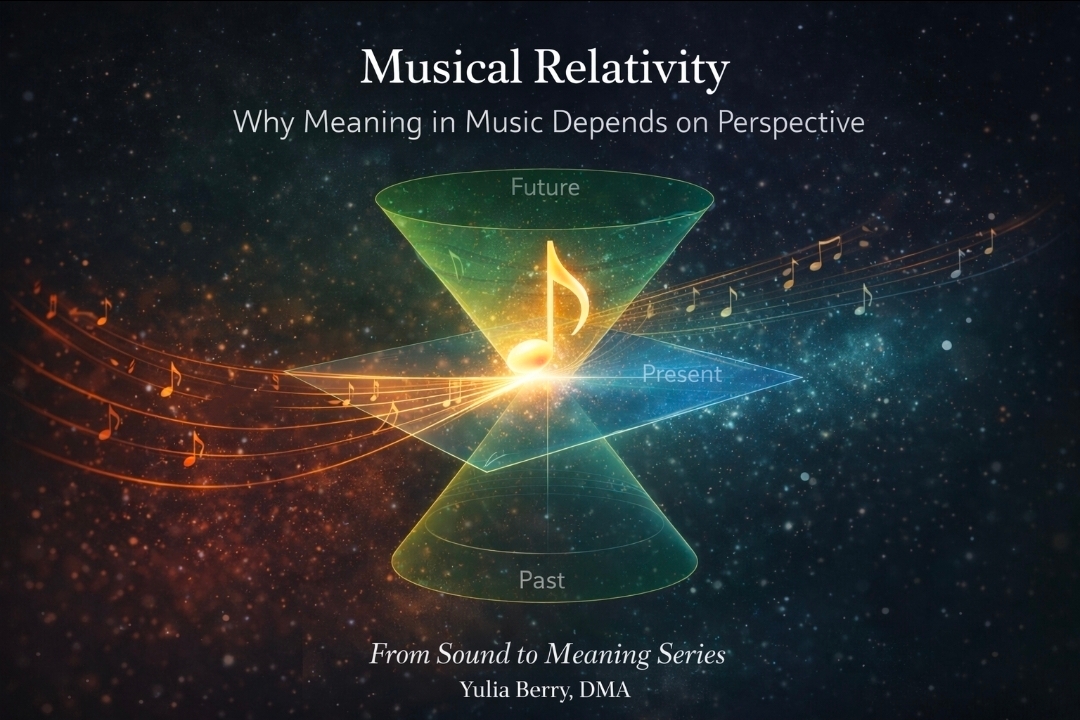
The Light Cone and Musical Time
In physics, every event creates a structure:
- A past cone: what influences the event
- A future cone: what the event can influence
- A present plane: what seems simultaneous
This is not just physics.
This is phrasing.
A note in music is never isolated. It exists inside its own “musical cone”:
- The past: what came before — harmony, gesture, expectation
- The future: where the phrase is going
- The present: the illusion of “now”
A student who plays only the present note is like an observer who ignores time.
The result is not meaning — it is fragmentation.
Why Meaning Is Not Absolute
Two listeners can hear the same performance differently.
Why?
Because they are not in the same “frame of reference.”
In the Theory of Relativity:
- Time stretches
- Events shift
- Simultaneity disappears
In music:
- Tempo feels different depending on tension
- Phrasing changes perceived structure
- Timing alters emotional meaning
Meaning is not in the sound alone.
Meaning emerges from relationships.
The Performer as Observer
A performer is not just producing sound.
They are choosing a frame of reference:
- What is important
- What is background
- What is tension, release, direction
This determines how the listener experiences time.
A great musician reshapes the listener’s perception — almost like bending time itself.
To understand this more clearly, we can imagine musical time not as a line, but as a field of relationships.
The Illusion of the Present
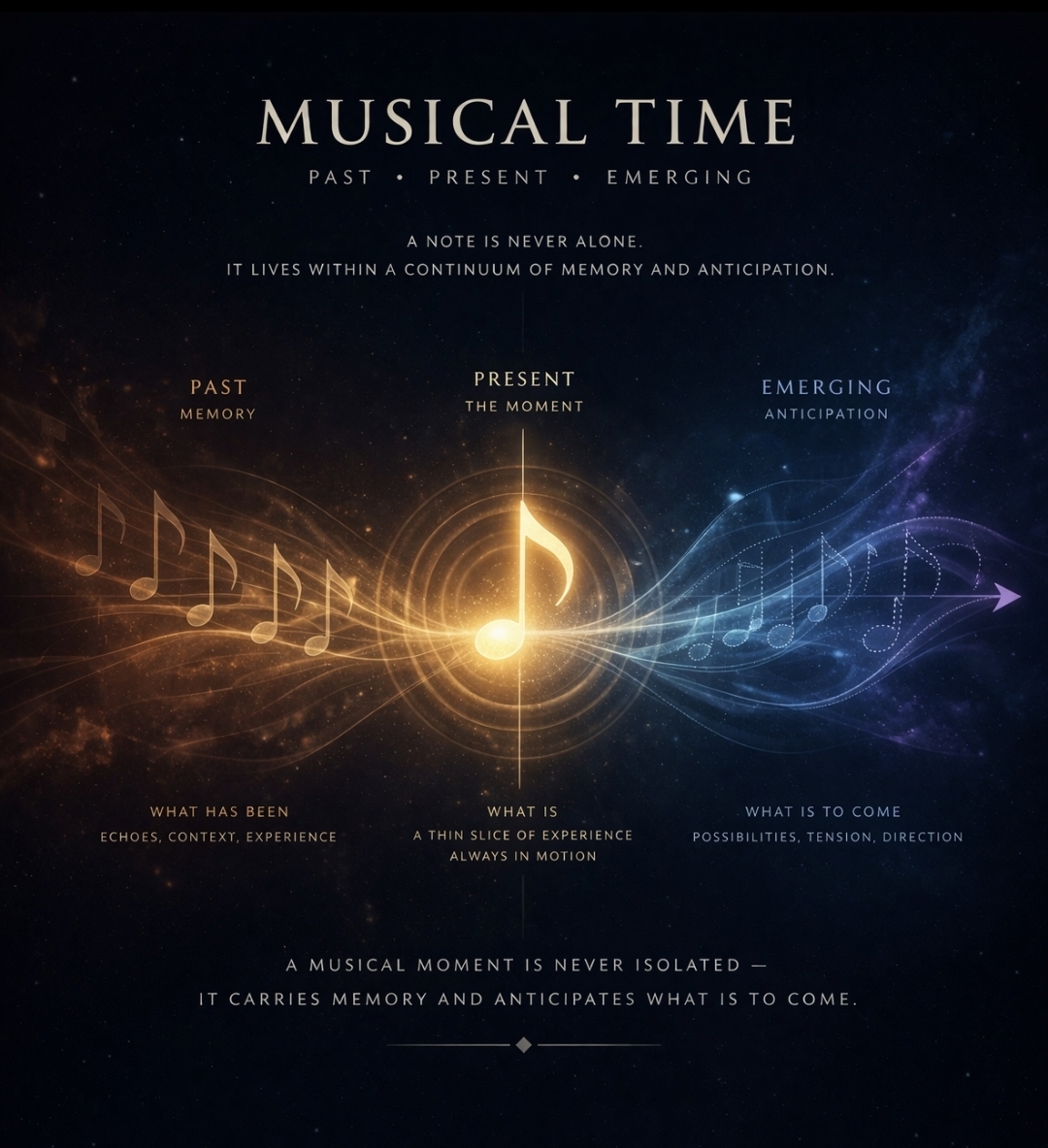
To see this more clearly, we can imagine musical time not as a line, but as a living continuum.
A musical moment is never isolated — it lives within memory and anticipation.
The “present” is only a thin slice — not stable, not universal.
In physics, it depends on where you stand and how you move.
Music works the same way.
There is no real “now” in performance.
Every note:
- Carries memory
- Anticipates direction
- Exists as part of a larger structure
When musicians play only what is “now,” they lose meaning.
Because meaning lives across time, not inside a single moment.
Where Meaning Actually Lives
Meaning is not:
- The note
- The tone
- The moment
Meaning lives in the coherence between past, present, and future.
This is why:
- Beautiful tone alone is not enough
- Expression without structure feels empty
- Precision without direction feels mechanical
Sound becomes meaning only when it is aligned in time.
A Quiet Realization
Physics tells us something deeply unsettling:
There is no single, objective timeline.
Music tells us something equally profound:
There is no single, objective meaning.
And yet — we feel meaning when everything aligns.
Not because it is fixed, but because it is coherent.
These reflections form part of a broader exploration of musical meaning.
There is a deeper layer to this — one that cannot be reduced to sound alone.
It emerges where perception, structure, and intention converge, where time is not measured, but experienced.
It is not a technique. It is a way of understanding.
And perhaps it begins in a place we rarely notice — somewhere between sound and time, where music begins to speak.
Continue Exploring the Book
These ideas are part of a larger philosophical journey in When Sound Becomes Meaning: A New Philosophy of Flute Interpretation, where sound, time, perception, structure, and expression are explored as one living field of musical meaning.