
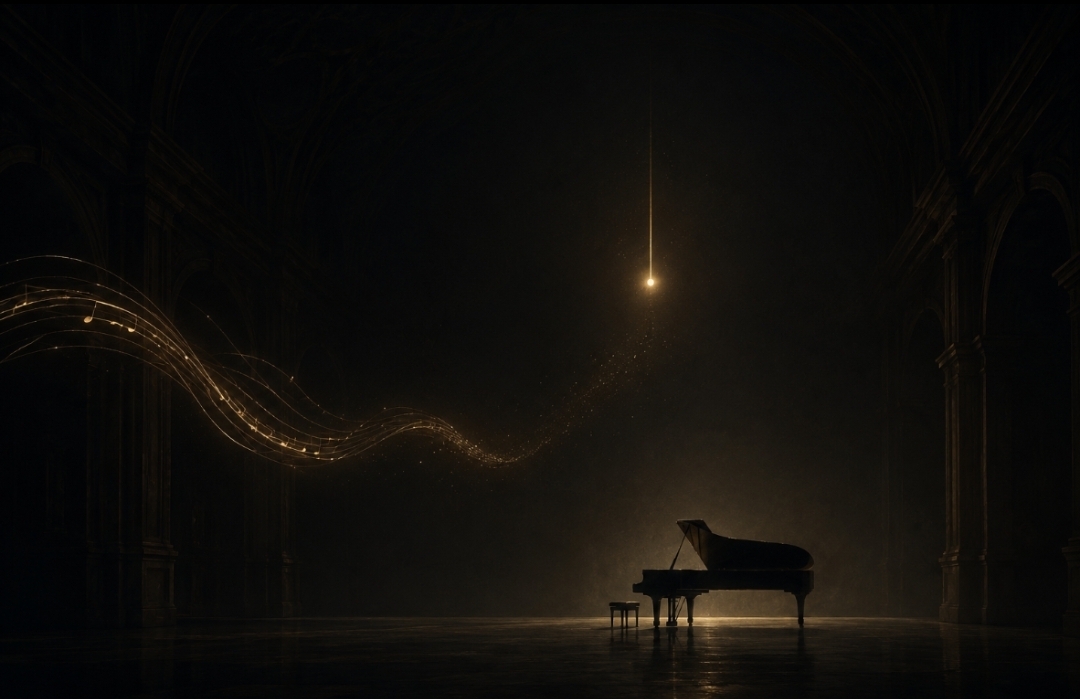
“Meaning depends not only on what appears,
but on what disappears.”
Why Silence Creates Meaning
Structure emerging through absence and restraint
Modern physics recently introduced a fascinating idea while exploring the hidden structure of reality.
Certain systems, researchers discovered, require not only interaction, but also carefully structured points of non-interaction in order to remain coherent.
The equations demanded moments where activity vanished.
The system could not remain stable through constant interaction alone.
At first glance, this appears purely mathematical.
But artistically, the idea feels strangely familiar.
Because music behaves the same way.
The Problem with Constant Sound
Young performers often believe musical meaning comes from continuous intensity:
continuous vibrato,
continuous rubato,
continuous emotional emphasis,
continuous projection.
Everything must constantly “say something.”
But over time, experienced musicians begin to sense a paradox.
Music suffocates when nothing is allowed to disappear.
Without silence: there is no breath.
Without restraint: there is no tension.
Without interruption: there is no form.
Constant expression eventually destroys expression itself.
Because meaning depends not only on what appears, but on what is withheld.
Silence Is Not Empty
A rest in music is not merely the absence of sound.
It is structured expectation.
The listener continues hearing internally even when the physical sound disappears.
In great performances, silence often becomes emotionally louder than the notes surrounding it.
A delayed resolution.
A suspended phrase ending.
A breath before arrival.
A cadence that waits slightly longer than expected.
These moments create psychological space where perception begins organizing meaning across time.
The music does not stop during silence.
In some sense, the silence becomes the music.
The Architecture of Restraint
This may explain why mature performers often play less, not more.
Not less musically.
Less unnecessarily.
They stop forcing emotion into every phrase.
They stop underlining every climax.
They stop trying to control every moment of listener response.
Instead, they begin shaping space itself.
And strangely, the performance often becomes far more powerful.
Because meaning rarely emerges through constant saturation.
It emerges through proportion.
Through balance.
Through the relationship between presence and absence.
Why Great Phrasing Breathes
Every great phrase contains disappearance.
A phrase cannot endlessly intensify.
A line cannot remain permanently suspended.
A climax cannot exist without release.
Music survives through cycles:
arrival and withdrawal,
tension and recovery,
sound and silence.
Even resonance itself depends on decay.
Without decay, resonance becomes noise.
And perhaps this applies not only to music, but to perception itself.
The mind requires interruption in order to recognize continuity.
Beyond Notes
This may be why certain performances feel exhausting despite technical brilliance.
Nothing disappears.
Every phrase demands attention.
Every note insists on importance.
Every moment is emotionally occupied.
The listener is never allowed to breathe.
But in truly great performances, something very different occurs.
The performer trusts absence.
Silence begins shaping emotional architecture as profoundly as sound itself.
And the listener experiences not merely information,
but space.
The Strange Possibility
Perhaps great music depends not only on sound, but on precisely structured moments where sound disappears.
Perhaps silence is not the opposite of meaning.
Perhaps it is one of the conditions that allows meaning to emerge at all.
Continue Into the Full Essay
Explore how absence, restraint, interruption, and non-action shape musical perception, emotional tension, and the hidden architecture of artistic meaning.
• why interruption creates continuity
• emotional architecture through restraint
• perception beyond constant stimulation
• the relationship between absence and meaning