
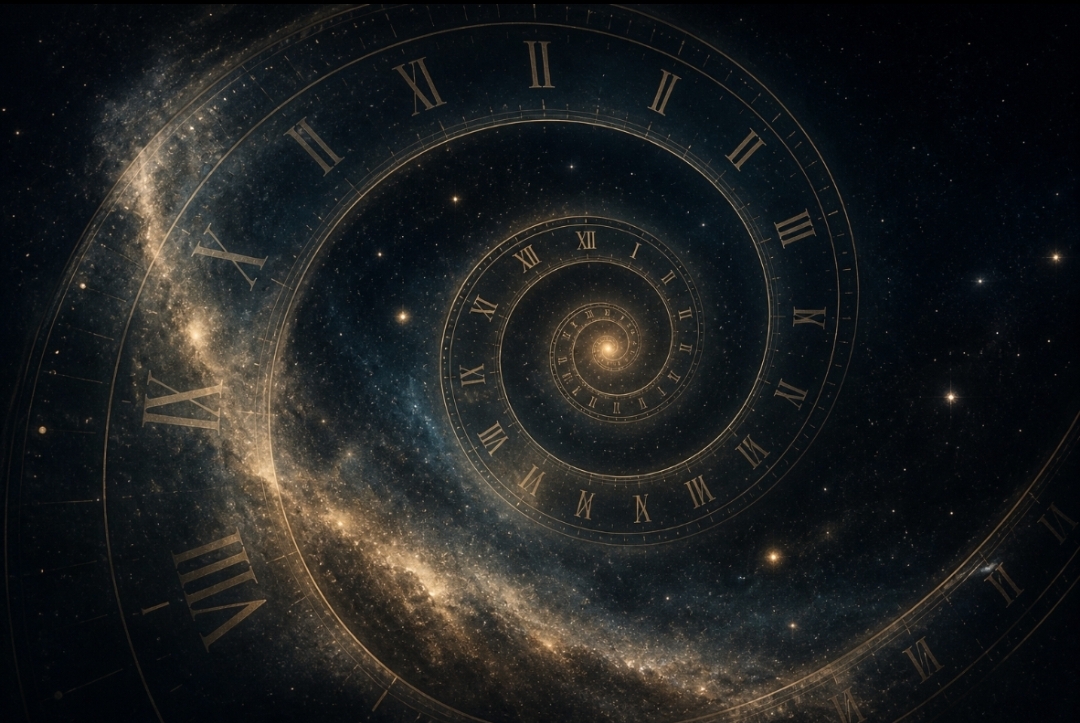
“Meaning may begin to unfold
before sound is fully present.”
Time, Perception, and the Structure of Musical Meaning
In recent work within quantum physics, researchers have described a phenomenon that appears, at first glance, impossible.
A particle of light — a photon — can seem to exit a system before it has fully entered it.
When measured under specific conditions, the time it spends within that system may register not merely as brief, but as negative.
This does not imply a reversal of causality.
Nor does it suggest that time flows backward.
But it leaves behind something more subtle — and more unsettling:
Time, as we perceive it, may not coincide with how processes actually unfold.
This observation belongs to physics.
But its implications extend further.
I. The Non-Linearity of Experience
In music, time is often treated as a sequence:
one event following another, governed by duration, tempo, and pulse.
But in experience, something else is happening.
The present is never isolated.
It is shaped continuously by what has already been heard, and by what is anticipated.
A phrase does not begin at the moment of its first audible sound.
It begins earlier.
In the preparation of breath.
In the harmonic direction already implied.
In the expectation formed by structure.
By the time the sound appears, its meaning is already in motion.
This suggests something difficult to reconcile with a purely linear model of time.
Meaning does not wait to be formed at the end of a process.
It is already unfolding — before the sound is fully present.
What follows changes how we understand musical time.
Continue Into the Full Essay
The essay continues beyond this point.
What follows examines how anticipation, perception, and structure reshape our understanding of musical time — and why meaning may emerge before it is fully heard.
The complete text is part of the private collection and is available with access.