
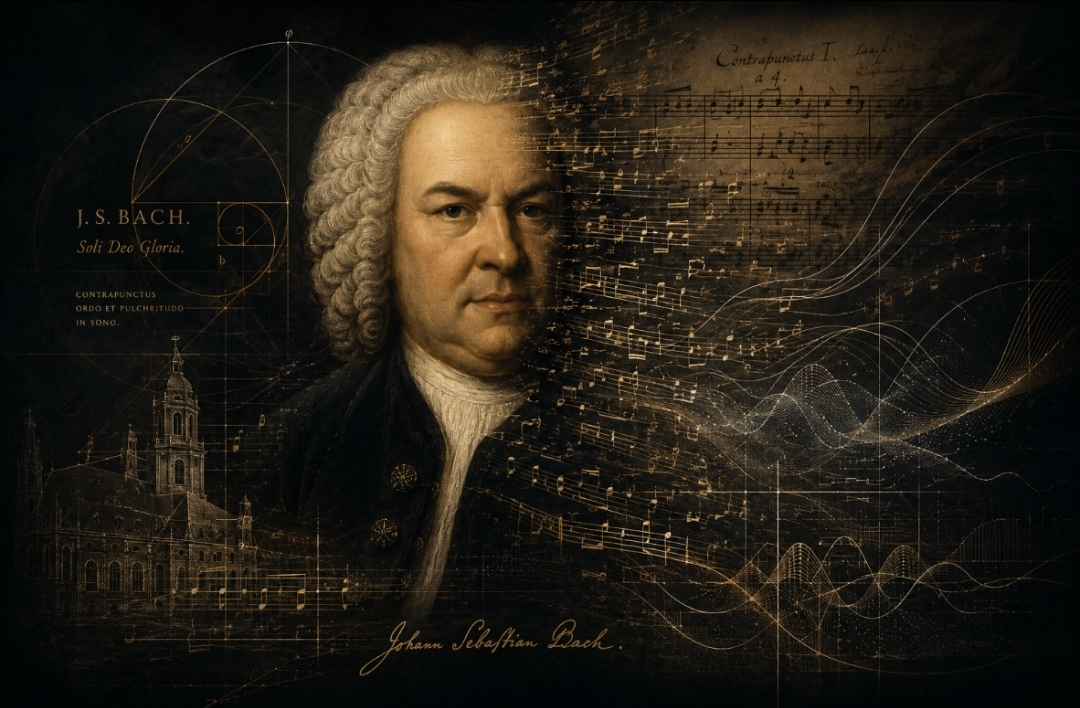
“Great music survives interpretation
because its meaning does not exist only on the surface.”
Interpretation, Structure, and the Mystery of Musical Identity
There is something extraordinary about great music that we almost never stop to examine.
A masterpiece can survive us.
It survives different performers, different centuries, different instruments, different aesthetics, and entirely different philosophies of interpretation.
Tempo changes.
Articulation changes.
Tone changes.
Dynamics change.
Entire traditions of performance practice rise and disappear.
And yet somehow:
Bach still sounds like Bach.
How is this possible?
Why does great music remain recognizable even when so much about its surface changes?
This question may reach deeper than interpretation itself.
Because if musical meaning depended entirely upon surface detail, masterpieces should collapse under interpretation.
But they do not.
Interpretation Changes Everything — Except the Work Itself
No two performers phrase identically.
No two artists shape time in precisely the same way.
Even the same performer changes from one evening to another.
A musical work exists not as a fixed sound object, but as an endlessly variable realization.
And yet, this variability does not destroy identity.
A pianist may broaden a cadence.
A flutist may delay resolution.
A conductor may stretch an architecture of tension across vastly different tempos.
Still, something survives.
Not merely the notes.
Not merely the score.
Something deeper.
We recognize the work as itself.
This recognition is so immediate that we rarely question how extraordinary it truly is.
Because in most areas of life, enough variation destroys identity.
And yet great music resists collapse.
Why?
Great Music Is Not Fragile
In many ways, masterpieces behave unlike fragile objects.
Fragile things break when disturbed.
Great works do not.
Instead, they tolerate astonishing degrees of variation while preserving coherence.
A Bach sarabande may sound meditative, architectural, intimate, severe, or deeply human — depending on the performer.
Yet listeners still perceive an underlying identity that remains intact.
The same phenomenon appears in Mozart.
One performance may emphasize elegance.
Another vulnerability.
Another dramatic tension hidden beneath classical balance.
And yet the work survives each transformation.
At first glance, this may seem obvious.
But philosophically, it is extraordinary.
The essence of great music may not exist entirely on its surface.
The Hidden Structure Beneath Interpretation
Modern physics has recently explored systems that remain stable not because they resist change, but because deeper structural relationships protect them from collapse.
The parallel to music is philosophical rather than scientific.
But it raises a profound possibility:
What if great music survives interpretation because it possesses a hidden structural coherence capable of preserving meaning through change?
If so, then interpretation may not be merely personal expression.
It may involve entering into relationships already capable of meaning before the performer even begins.
And this changes the question entirely.
The deepest issue may no longer be:
How should we interpret a work?
But rather:
What is it within great music that survives us?
Continue Reading the Full Essay
The complete premium essay, The Music That Cannot Collapse, explores why some interpretations preserve meaning while others weaken it — and how structure, freedom, Bach, and the hidden architecture of musical coherence reveal something essential about the nature of meaning itself.