
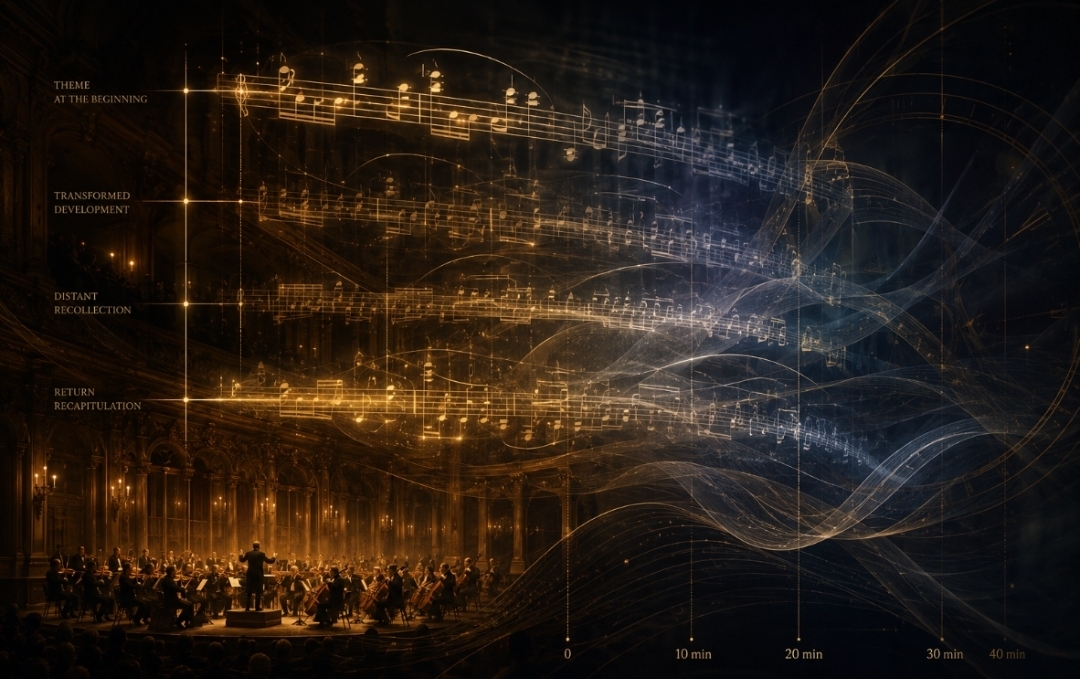
“Meaning in music emerges not from single sounds,
but from invisible connections between distant moments.”
The Hidden Relationships Between Quantum Entanglement, Memory, and Musical Meaning
A musical note disappears almost instantly.
The vibration fades. The air becomes silent. Physically, the sound no longer exists.
And yet music somehow continues connecting sounds that have already vanished.
A theme introduced at the beginning of a symphony may suddenly return forty minutes later carrying emotional memory, structural transformation, and psychological meaning accumulated across the entire journey.
The listener experiences distant moments as invisibly connected, even though the original sounds disappeared long ago.
Music unfolds sequentially through time, yet it is experienced as an interconnected whole.
Music remembers what no longer exists physically.
What Quantum Entanglement Revealed
In 1935, Albert Einstein, Boris Podolsky, and Nathan Rosen challenged one of the strangest predictions of quantum mechanics.
According to the theory, two particles that interact can become “entangled,” forming a single correlated system even after being separated by enormous distances.
Measuring one particle determines the corresponding state of the other, not because a visible signal travels between them, but because the two particles belong to one shared quantum relationship.
Einstein rejected the idea completely. He famously mocked it as “spooky action at a distance,” believing that reality must consist of independent objects with fixed properties existing separately from observation.
Yet decades of experiments confirmed that quantum entanglement is real.
The universe does not behave entirely as a collection of isolated objects. Relationships, correlations, and hidden structural connections can themselves become fundamental parts of reality.
This does not mean music literally operates through quantum mechanics.
The connection is philosophical.
Both music and entanglement challenge the idea that meaning belongs primarily to isolated things.
Both reveal the importance of relationships extending beyond immediate presence.
The Strange Persistence of Musical Memory
A melody is never experienced as isolated notes.
Each sound changes the meaning of the sounds before it.
Consider the opening of Beethoven’s Fifth Symphony.
The famous four-note motif — short-short-short-long — is not perceived as four separate events.
The fourth note transforms the entire gesture retroactively. Without the arrival, the first three notes remain incomplete.
Even more remarkably, the motif continues shaping the listener’s perception throughout the symphony.
Every later appearance carries memory with it.
Each recurrence becomes connected not only to the immediate musical context, but also to every previous appearance stored in the listener’s mind.
The motif becomes a persistent structural presence long after the original sound waves disappeared.
The meaning of a musical moment often depends on sounds that are no longer present.
Music therefore behaves less like a chain of isolated events and more like a unified field extending across time.
Meaning does not emerge from individual sounds. It emerges from relationships between distant moments.
Bach and the Architecture of Invisible Relationships
This phenomenon becomes even more extraordinary in the music of Johann Sebastian Bach.
In a fugue from The Well-Tempered Clavier, a subject introduced in the opening measures may later appear inverted, stretched rhythmically, compressed, hidden in an inner voice, or combined with countersubjects simultaneously.
The listener often cannot consciously track every transformation. Yet the mind perceives continuity.
Why?
Because musical memory remains correlated with earlier states of the work.
A hidden return of the subject suddenly activates recognition across enormous spans of time.
Earlier material becomes psychologically present again, even though it vanished minutes earlier.
The fugue behaves less like a sequence and more like an interconnected organism.
A fugue behaves less like a sequence of notes
and more like an interconnected field of memory.
When the Future Changes the Past
Music also does something profoundly strange: later events can alter the meaning of earlier ones.
In sonata form, the recapitulation often feels emotionally overwhelming not because the notes themselves changed, but because the listener has changed through the musical journey.
Conflict, instability, modulation, fragmentation, and tension transform the psychological meaning of the returning theme.
The opening theme becomes filled with accumulated memory.
In other words: the future reshapes the past.
This becomes especially powerful in the operas of Richard Wagner.
In Wagner’s music dramas, leitmotifs associated with characters, emotions, or destinies recur across enormous multi-hour structures.
A listener hearing a brief harmonic progression or melodic fragment may suddenly experience emotional associations accumulated hours earlier.
The sound itself is small. The memory field attached to it is immense.
In music, the future can reshape the emotional meaning of the past.
Mozart and the Emotional Power of Expectation
Even the simplest tonal music demonstrates how deeply musical meaning depends on memory and anticipation.
In the slow movement of Mozart’s Flute Concerto No. 2 in D major, small suspensions and appoggiaturas can feel emotionally devastating.
The effect does not exist inside isolated notes themselves.
It emerges because the listener unconsciously retains tonal expectation, phrase structure, harmonic direction, breath pacing, and remembered patterns from earlier moments.
A single delayed resolution can create extraordinary emotional tension because the mind continues carrying relationships forward through time.
The music points beyond itself toward anticipated arrival.
Meaning therefore exists partly in what has already disappeared
and partly in what has not yet arrived.
The Flute and the Continuity of Disappearing Sound
No instrument reveals this mystery more clearly than the flute.
Unlike the piano, whose resonance can linger naturally, flute sound begins disappearing immediately after breath leaves the instrument.
Every tone vanishes almost as soon as it is born.
And yet great flute music creates astonishing continuity across disappearance.
In Debussy’s Syrinx, phrases emerge and dissolve almost like remembered sound rather than stable structure.
Motives return not as literal repetitions, but as transformed fragments shaped by contour, breath, silence, and tonal color.
The listener experiences continuity not through strict form, but through subtle relationships carried internally through memory.
Meaning exists partly in what is no longer sounding.
Edgard Varèse’s Density 21.5 creates a completely different kind of temporal interconnectedness.
Certain gestures return transformed: registral explosions, intervallic cells, rhythmic attacks, and timbral contrasts.
At first the work can sound fragmented and disconnected.
Yet over time the listener begins perceiving hidden structural relationships linking distant events together.
The coherence emerges retrospectively.
The piece teaches the listener how to hear it.
In Carl Reinecke’s Undine Sonata, flowing motives associated with water continually return transformed by emotional and narrative context.
Earlier material remains psychologically active throughout the sonata, creating the sensation that the music remembers itself.
Similarly, André Jolivet’s Chant de Linos alternates between lament, ritual, ecstasy, and incantation.
Motivic fragments recur almost like ancient memories resurfacing across time.
The flute reveals continuity through disappearance.
The Experience of Connected Time
The true connection between quantum entanglement and music is not technological or literal.
It is perceptual and structural.
In quantum physics, particles can remain correlated across distance.
In music, distant moments can remain psychologically connected across time.
A symphony unfolds moment by moment, yet the listener rarely experiences it as isolated fragments.
Earlier themes remain active inside memory.
Future resolutions reshape earlier tension.
Returning motifs awaken emotional associations accumulated throughout the work.
The listener continuously carries the past forward while anticipating what has not yet arrived.
This is one of music’s most extraordinary abilities:
It transforms separate moments into perceived continuity.
Sound fades.
Relationships remain.
This is why great music can feel larger than linear time.
Not because sound physically survives, but because the mind continues weaving relationships between moments that no longer exist acoustically.
Music therefore becomes more than organized sound.
It becomes an experience of connected time.
Explore the Book
Entangled Time is part of Yulia Berry’s ongoing From Sound to Meaning series, exploring musical memory, perception, structure, and the hidden relationships that shape musical experience across time.
These ideas are explored more deeply in When Sound Becomes Meaning: A New Philosophy of Flute Interpretation, where sound, time, perception, interpretation, and structure open into a broader philosophy of musical meaning.