
Yulia Berry
Toward Meaning
“Western civilization did not simply inherit Greek ideas.
It inherited Greek ways of organizing perception.”
How Ancient Greece Shaped the Architecture of Western Thought
Most civilizations created myths. Ancient Greece created systems. And those systems still shape how the modern world thinks.
The influence of Ancient Greece is often discussed through familiar inventions: democracy, philosophy, theater, geometry, rhetoric, logic. Yet the true Greek legacy runs much deeper than individual disciplines or historical achievements. Ancient Greece helped establish the intellectual architecture through which Western civilization learned to perceive reality itself.
Its influence is not limited to politics or philosophy classrooms. It extends into music, aesthetics, education, science, architecture, literature, morality, and even the modern understanding of beauty and meaning.
That transformation changed history permanently.
The Shift From Myth to Structure
Before Ancient Greece, many civilizations explained reality primarily through divine narrative. Storms, fate, suffering, love, illness, and political power were understood through mythology and sacred tradition. The world was interpreted through stories of gods and cosmic forces.
The Greeks did not abandon mythology entirely. In fact, Greek mythology remains one of the greatest imaginative systems ever created. But alongside myth, something radically new emerged: the belief that reality might possess an underlying order that could be understood through reason, proportion, observation, and structure.
This was one of the great turning points in human intellectual history.
Greek thinkers began asking different kinds of questions:
What is the world made of?
What is justice?
Why does harmony exist?
What makes something beautiful?
Can truth be discovered through reason?
Is there order beneath appearance?
These questions transformed civilization itself.
The Greeks did not merely seek explanations. They sought principles.
And from this search emerged philosophy, formal logic, mathematics, political theory, aesthetics, dramatic structure, scientific reasoning, and musical proportion.
Why Beauty Became Structural
One of Ancient Greece’s most enduring contributions was the idea that beauty is not merely decorative or subjective.
For the Greeks, beauty reflected order.
Proportion.
Balance.
Harmony.
Coherence.
Beauty was often understood as evidence that separate elements had entered into meaningful relationship with one another.
This idea shaped nearly every aspect of Western aesthetics.
Greek architecture emphasized symmetry and proportion. Greek sculpture pursued idealized balance between realism and perfection. Greek rhetoric sought persuasive elegance through structure and rhythm. Greek tragedy relied on carefully organized dramatic tension and catharsis.
Even today, Western art still unconsciously carries many of these assumptions.
Concert halls are designed around acoustic balance and proportion. Classical musical forms rely on structural relationships. Narratives develop through tension and resolution. Visual composition often seeks symmetry, contrast, and coherence.
The Greek concept of harmony itself reveals this deeper worldview.
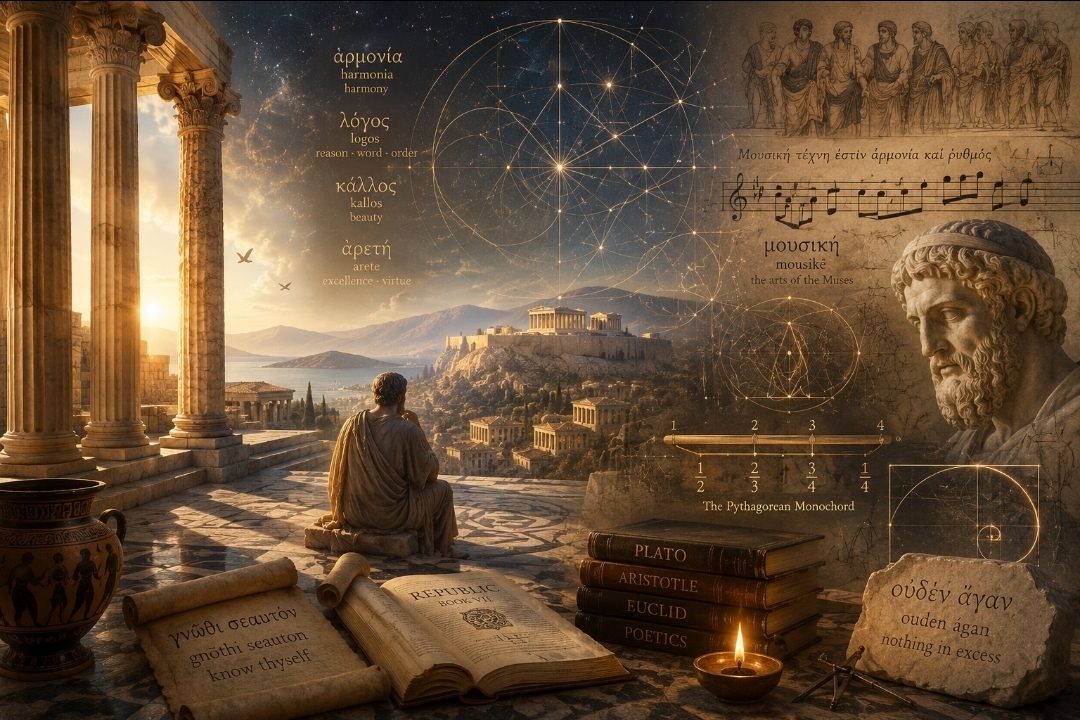
The word harmonia originally referred not simply to pleasing sound, but to joining, fitting together, proper arrangement.
Harmony was not decoration.
It was intelligibility.
A sign that different parts could become unified without losing their identity.
Music as a Model of Cosmic Order
Perhaps nowhere was the Greek worldview more profound than in music.
Modern culture often treats music as entertainment, personal expression, or emotional experience. But for the Greeks, music belonged to something much larger.
The Greek concept of mousikē did not refer only to music in the modern sense. It encompassed poetry, rhythm, education, memory, language, and the cultivation of the soul through the arts of the Muses.
Music was philosophical.
Mathematical.
Ethical.
Cosmological.
Pythagorean thinkers made one of the most revolutionary discoveries in intellectual history: musical intervals could be expressed through numerical relationships.
Suddenly, beauty appeared measurable.
Harmony was no longer merely emotional sensation. It reflected mathematical order.
This idea profoundly shaped Western civilization.
The belief that invisible relationships could generate intelligible beauty echoed through: classical music, counterpoint, Renaissance aesthetics, architecture, acoustics, scientific thought, and eventually even modern physics.
Western music inherited far more than scales and theoretical systems from Greece.
It inherited the belief that coherence itself can produce meaning.
That relationships matter more than isolated elements. That structure can generate emotional and intellectual depth simultaneously.
Plato and the Search for Ideal Beauty
Greek philosophy also transformed how the West understood perfection itself.
Plato proposed that physical reality is incomplete — a world of imperfect reflections pointing toward deeper ideal forms.
Beauty, in this view, was not simply personal preference. It was connected to something transcendent.
This idea influenced centuries of Western thought: Christian theology, Renaissance art, classical aesthetics, educational ideals, and artistic perfectionism.
Even modern artistic interpretation often reflects Platonic thinking.
A performer does not merely reproduce notes mechanically. The performer attempts to approach an ideal musical truth that can never fully materialize physically.
The performance becomes an act of approximation toward something greater than itself.
This tension between the ideal and the physical still lies at the center of much Western art.
Aristotle and the Birth of Organized Knowledge
If Plato elevated abstract ideals, Aristotle organized reality itself.
Aristotle classified systems of logic, ethics, politics, rhetoric, biology, drama, and observation with extraordinary precision. His influence on Western education remains immense even now.
Modern academia still largely operates through Aristotelian habits: categorization, analysis, formal reasoning, systematic observation, structured argument.
Even the scientific method partially descends from Greek assumptions that reality can be studied through rational investigation and observable relationships.
This intellectual structure became foundational for the Western world.
Why Western Art Still Thinks Greekly
Although modern culture often imagines itself far removed from Ancient Greece, many of its deepest assumptions remain unmistakably Greek.
Western civilization still tends to value: coherence, individuality, dramatic structure, ideal beauty, rational explanation, proportion, catharsis, formal development, and intelligible order.
Even contemporary cinema frequently follows dramatic structures inherited from Greek tragedy.
Classical music still depends on tension and release. Architecture still seeks proportional balance. Philosophy still pursues conceptual clarity. Education still values structured reasoning.
The Greek intellectual framework became so deeply embedded in Western civilization that it often feels invisible.
We think within structures partially inherited from Greece
without realizing their origin.
The Fragmentation of Modern Culture
Yet modern culture also differs profoundly from the Greek worldview.
Ancient Greek thought often treated philosophy, music, mathematics, ethics, politics, cosmology, rhetoric, and education as interconnected manifestations of order.
Modern civilization fragmented these into isolated disciplines.
Music became separated from philosophy. Science from beauty. Mathematics from emotion. Technique from meaning.
Specialization produced extraordinary advances. But it also weakened the sense of unity that once connected knowledge, art, ethics, and human experience.
Perhaps this fragmentation partially explains why modern culture often struggles to sustain coherent meaning despite possessing unprecedented information.
Human understanding deepens when structure,
beauty, thought, and experience remain connected.
Conclusion
Ancient Greece did not merely contribute ideas to Western civilization.
It helped establish the frameworks through which the West learned to perceive: beauty through proportion, truth through reason, music through harmony, drama through structure, and meaning through relationships that endure across time.
Its influence extends far beyond marble ruins or philosophy textbooks.
It lives inside the architecture of Western thought itself.
And even now, centuries later, much of modern civilization still thinks in Greek patterns — often without realizing it.
Continue Exploring Sound and Meaning
These ideas continue throughout When Sound Becomes Meaning: A New Philosophy of Flute Interpretation — exploring coherence, perception, structure, memory, harmony, and the hidden relationships through which music becomes meaningful.
The book expands these philosophical explorations through music, aesthetics, interpretation, resonance, and the deeper architecture of artistic meaning.
Explore the Book