
Yulia Berry
Toward Meaning
Why We Listen to the Disappearance of Possibilities
“The listener lives within a constantly changing field of unrealized futures.”
A curious thing happens when we listen to music.
We think we are hearing notes.
In reality, we are hearing possibilities.
Consider a simple melody.
The first few notes sound, and almost immediately the mind begins predicting what might happen next. Will the phrase rise higher? Will it fall? Will it resolve? Will it surprise us?
We rarely notice this process because it happens automatically.
Yet it is always there.
Listening is not passive.
It is an act of anticipation.
The listener continually imagines possible futures before the music reveals which one will actually occur.
This may explain why music affects us so deeply.
Music does not simply present events.
It continually transforms possibility into reality.
Bach and the Illusion of Inevitability
Few composers demonstrate this more beautifully than Johann Sebastian Bach.
After hearing one of Bach’s phrases unfold, we often think:
“Of course. It had to happen that way.”
The cadence feels inevitable.
The harmony feels logical.
The melodic line appears perfectly natural.
Yet this feeling is deceptive.
Before the cadence arrived, the listener did not know exactly how it would unfold.
Before the modulation occurred, its destination remained uncertain.
Before the final note sounded, many continuations were possible.
The sense of inevitability appears only after the choice has been made.
Once the answer is revealed, the mind forgets the alternatives.
What feels destined was once uncertain.
Part of Bach’s genius lies in making the chosen path appear so convincing that we forget all the paths that disappeared along the way.
Meaning and Unrealized Futures
This observation points toward something larger.
Meaning is not created solely by what happens.
It is also shaped by what does not happen.
A deceptive cadence is meaningful because another cadence was expected.
A suspension is meaningful because resolution has been delayed.
A surprising modulation matters because the listener anticipated a different destination.
Every musical event exists against a background of unrealized possibilities.
The listener may not consciously identify them, yet they remain psychologically present.
The music gains meaning from their disappearance.
The Note That Eliminates Possibilities
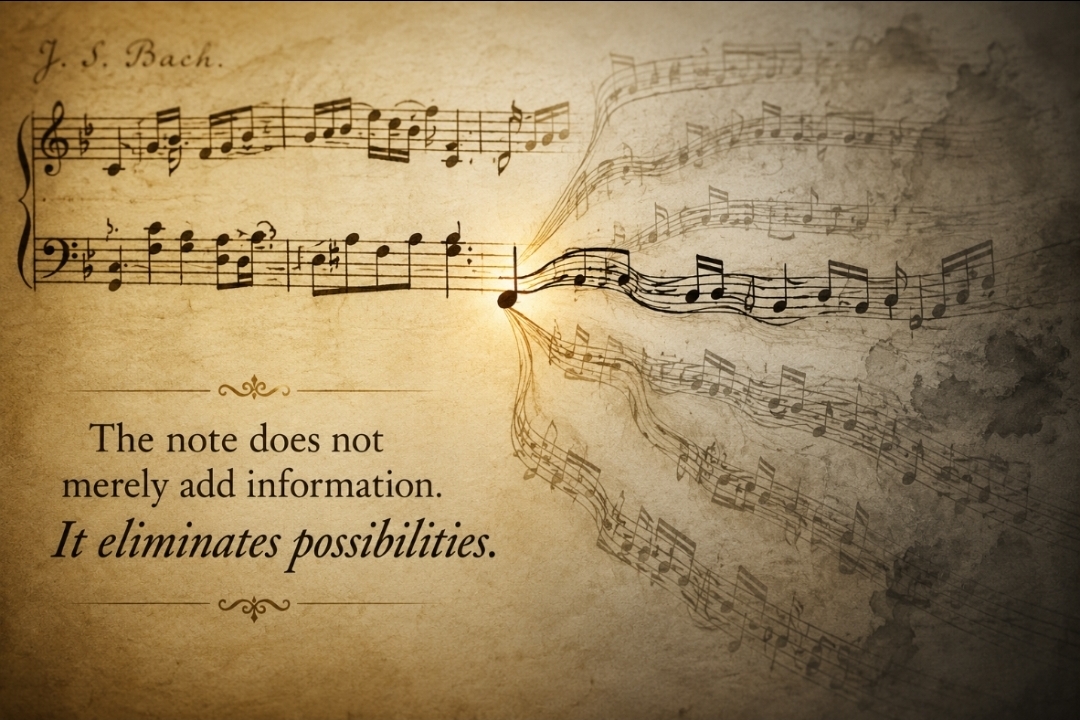
When a new note arrives, it does more than add information.
It eliminates possibilities.
For a brief moment, multiple futures seem possible.
Then one note appears.
One future becomes real.
The others vanish.
This process repeats continuously throughout a performance.
Possibility.
Choice.
Possibility.
Choice.
Possibility.
Choice.
A musical work is not experienced as:
note → note → note → note
but as:
possibility → choice → possibility → choice → possibility → choice
The listener lives within a constantly changing field of unrealized futures.
Music Exists in Participation
This may also explain why different listeners hear different meanings in the same performance.
The sound waves are identical.
The listeners are not.
Each listener brings different memories, experiences, expectations, and associations.
The performer shapes sound.
The listener shapes possibility.
Meaning emerges through their interaction.
Music therefore does not exist entirely in the score,
the instrument, or the air.
It exists in participation.
The Disappearance of Possibilities
Perhaps this is why great music feels larger than the notes themselves.
The physical sounds occupy only a small part of the experience.
Surrounding them is an invisible world of expectation, anticipation, memory, and imagination.
A melody is not merely a sequence of pitches.
It is a sequence of possibilities.
A cadence is not merely a harmonic event.
It is the resolution of uncertainty.
A silence is not merely the absence of sound.
It is a space filled with unrealized futures.
We often think that music moves us because of what happens.
But perhaps it moves us just as much because of everything that could have happened and did not.
Perhaps we do not merely listen to notes.
We listen to possibilities becoming real.
And to all the futures that disappear along the way.
Continue Exploring Sound and Meaning
These ideas continue throughout When Sound Becomes Meaning: A New Philosophy of Flute Interpretation — exploring meaning, memory, anticipation, structure, coherence, and the hidden relationships through which music becomes meaningful.
The book expands these philosophical explorations through music, aesthetics, interpretation, and the deeper architecture of meaning itself.
Explore the Book