
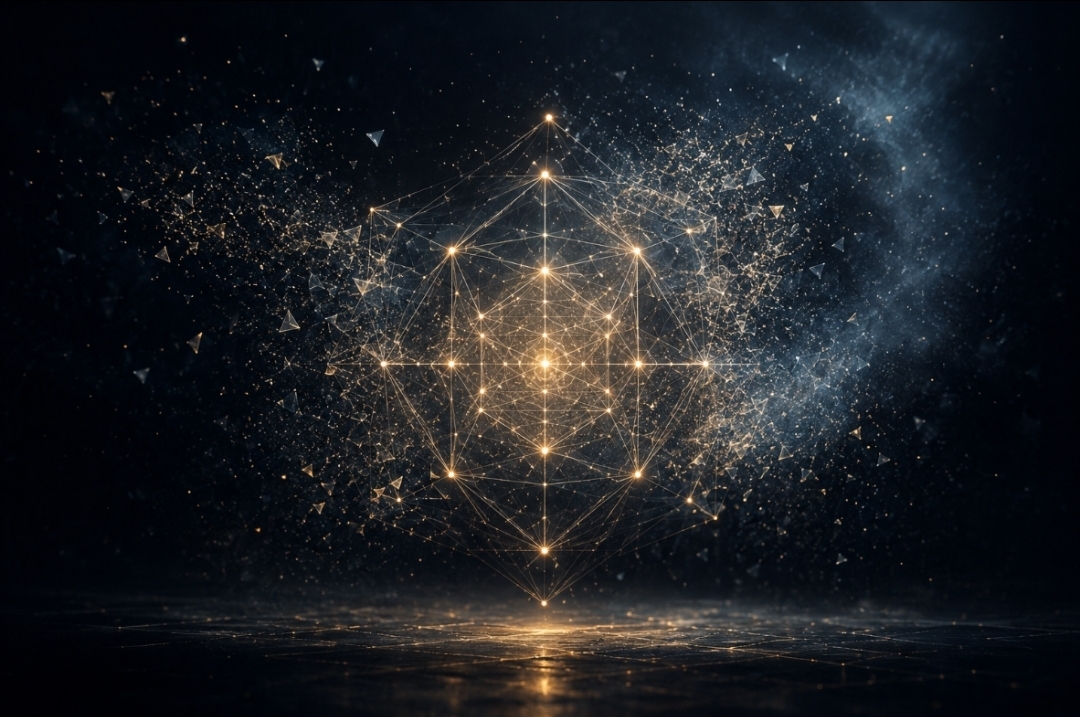
“Meaning survives only when relationships remain coherent across time.”
A reflection on music, memory, and the fragile architecture of coherence
The Problem of Fragile Information
A recent scientific proposal introduced a strange and fascinating possibility.
Researchers working in quantum information theory described a theoretical system capable of preserving fragile quantum information for extraordinarily long periods of time — not through constant external repair, but through structure itself.
In most quantum systems, information quickly collapses under disturbance.
Heat, noise, and interaction with the environment gradually destroy coherence.
To prevent this, modern quantum computers require continuous correction and enormous external effort simply to preserve stability for brief moments.
But the newly proposed system attempts something radically different.
Instead of constantly repairing errors from outside, the system is designed so that disorder becomes increasingly difficult to spread internally.
Larger disturbances require increasingly larger energetic costs.
As the structure deepens, instability itself encounters resistance.
The system protects coherence through organization.
When Sound Disappears
And strangely enough, something profoundly similar happens in music.
A melody survives only briefly in the air.
Meaning survives much longer.
But only if something preserves the relationships between moments after the sound itself disappears.
This may explain why musical meaning cannot be reduced to isolated notes, emotional intensity, or technical precision alone.
Meaning emerges when relationships remain coherent across time.
A beautiful sound may capture attention for a moment.
A meaningful performance sustains connection between moments long after individual sounds vanish.
Weak Structure and Strong Structure
This is why great musical interpretation often feels fundamentally different from surface-level expressivity.
Some performances attempt to create meaning through constant emotional pressure:
exaggerated rubato,
continuous intensity,
dramatic gestures,
surface effects.
But because the underlying structure is weak, the interpretation begins to collapse once disturbance appears.
The performance may feel impressive moment to moment, yet lose identity across larger spans of time.
Other performances behave differently.
Even with imperfections, something remains stable beneath the surface.
Phrases continue to belong to one another.
The architecture survives interruption.
The listener still senses direction, proportion, and inevitability.
The meaning survives because coherence survives.
This may be one of the deepest differences between weak and strong artistic structure.
Weak structure depends on constant stimulation.
Strong structure absorbs disturbance without losing identity.
The Collapse of Coherence
And perhaps this distinction extends far beyond music.
Modern culture increasingly surrounds human attention with interruption:
short-form media,
fragmented information,
algorithmic stimulation,
continuous novelty,
constant emotional acceleration.
Yet meaning itself may require precisely what fragmentation destroys:
Stable relationships across time.
A culture overwhelmed by interruption struggles to sustain meaning because meaning itself depends on coherence.
Not simply information.
Not stimulation.
Not intensity.
Coherence.
Why Some Experiences Still Feel Different
This may explain why certain experiences still feel profoundly different from ordinary digital life:
reading a great novel,
listening to a symphony,
following a philosophical argument,
remembering a childhood home,
sustaining a lifelong friendship.
In each case, meaning does not emerge from isolated moments.
It emerges from relationships that remain connected long enough to form structure.
Without structure, experience dissolves into fragments.
Without coherence, memory weakens into sensation.
Without continuity, time becomes noise.
The Architecture of Meaning
And perhaps this is why great art often feels strangely resistant to collapse.
Not because it avoids fragility, but because it organizes fragility into something capable of surviving time.
Unlock the Full Essay
Continue exploring coherence, memory, instability, structure, and the hidden relationships through which meaning survives across time.
Part of the ongoing philosophical series connected to When Sound Becomes Meaning.