
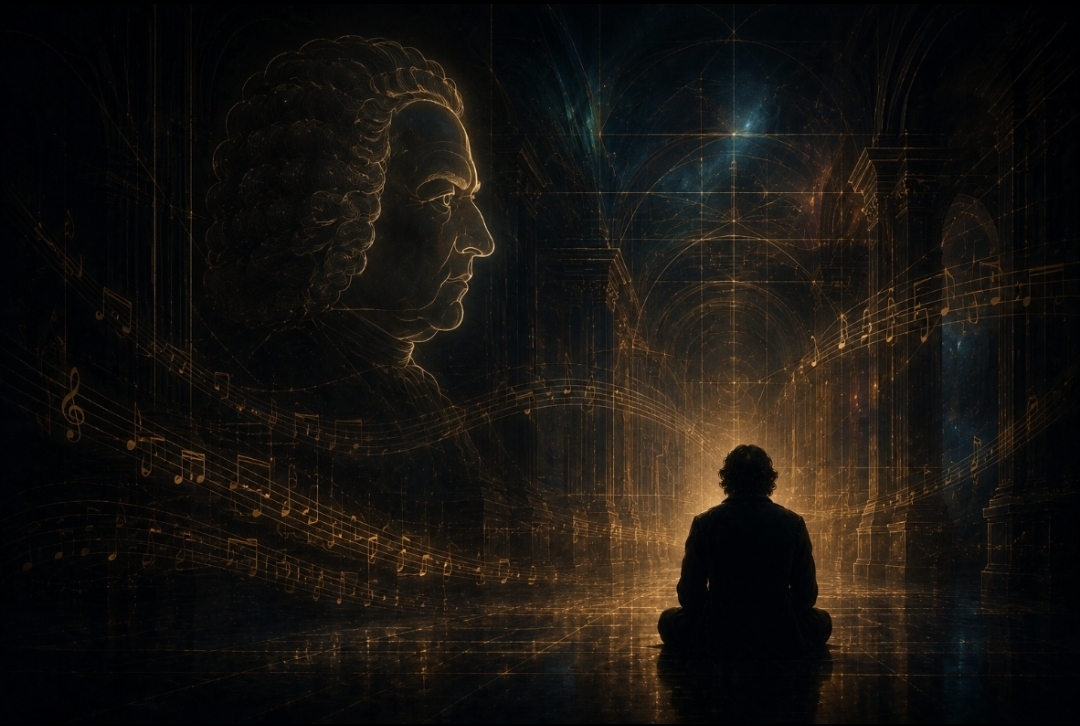
“Music does not remember.
The listener does.”
Memory, Music, and the Illusion of Coherence
There is a deeply unsettling idea in modern physics.
It asks whether memory can truly prove the past.
What if the sensation of continuity is not the same as continuity itself?
What if a mind could experience a coherent history — memories, perceptions, emotions, and meaning — without that history having unfolded in the way it appears?
This is the disturbing question behind the Boltzmann brain paradox, a thought experiment in physics and cosmology that challenges one of our most basic assumptions:
That what feels remembered must have truly happened.
Music and the Reconstruction of Time
At first, this seems far removed from music.
But music may be one of the most profound artistic places where this problem appears.
A listener hears a phrase return and experiences memory.
A cadence arrives and feels inevitable.
A theme transforms, and suddenly the earlier music seems to have been preparing for it all along.
Yet the sound itself remembers nothing.
The air does not preserve the phrase.
The vibration does not know it is returning.
Only the listener reconstructs continuity from what has already disappeared.
This means that musical meaning is not simply contained in the notes.
It emerges through memory, structure, expectation, and time.
Why Coherence Feels Like Truth
And this is where the question becomes more than scientific.
It becomes musical.
It becomes philosophical.
Because music reveals how easily coherence can feel like truth.
A resolution can make instability seem purposeful.
A return can make the past feel confirmed.
A structure can create the sensation that everything was inevitable from the beginning.
But is inevitability something music possesses?
Or is it something the listener creates after the fact?
Meaning may emerge not from isolated events,
but from patterns capable of stabilizing perception across time.
The Question Beneath the Music
This question opens into one of the deepest problems of musical meaning:
How can sound — which disappears the moment it is born — nevertheless create the feeling of memory, destiny, and emotional truth?
The full essay explores this question through music, memory, perception, and the architecture of meaning — including why composers such as Bach can make the past seem to change while remaining exactly the same.
Continue Reading the Full Essay
The complete premium essay, When Meaning Remembers What Never Happened, explores how music creates the sensation of memory, continuity, and inevitability — and how sound, structure, Bach, and perception reveal something profound about the nature of meaning itself.