
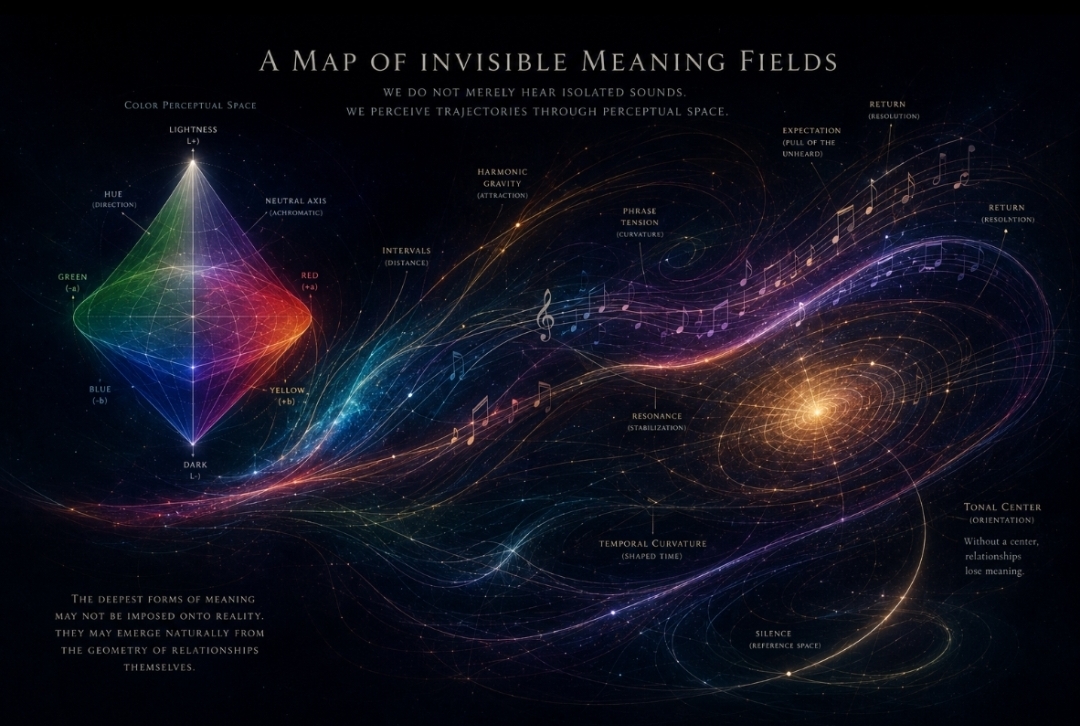
“Perhaps meaning is not something consciousness invents.
Perhaps it is something structure allows us to perceive.”
Schrödinger, Color, and the Hidden Geometry of Musical Meaning
Nearly a century ago, Erwin Schrödinger proposed something astonishing:
that color perception might not simply be a psychological decoration imposed onto reality, but something emerging from the internal geometry of perception itself.
His idea remained incomplete for decades.
The mathematics could not fully explain how human beings perceive hue, saturation, lightness, and orientation within color space.
Yet the intuition behind it was hauntingly powerful:
Perhaps perception contains hidden structures that shape meaning long before conscious interpretation begins.
Recent research has returned to this vision with a striking conclusion.
Color perception cannot be modeled properly through straight lines and flat geometry.
Human perception behaves differently.
It bends.
It curves.
It follows paths through relational space.
And suddenly, this begins to sound strangely familiar to musicians.
We do not merely hear isolated sounds.
We perceive trajectories through perceptual space.
But if meaning emerges through orientation, curvature, and relationships within perception itself, then the implications extend far beyond color theory — and far beyond music analysis.
The deeper question is not merely how we hear sound, but how consciousness itself navigates structured meaning through time.
Continue Reading the Full Essay
The complete premium essay explores perceptual gravity, tonal centers, curved musical time, and the hidden geometry through which meaning emerges from relationships themselves — revealing how structure, perception, and consciousness may participate in a deeper architecture of meaning.