
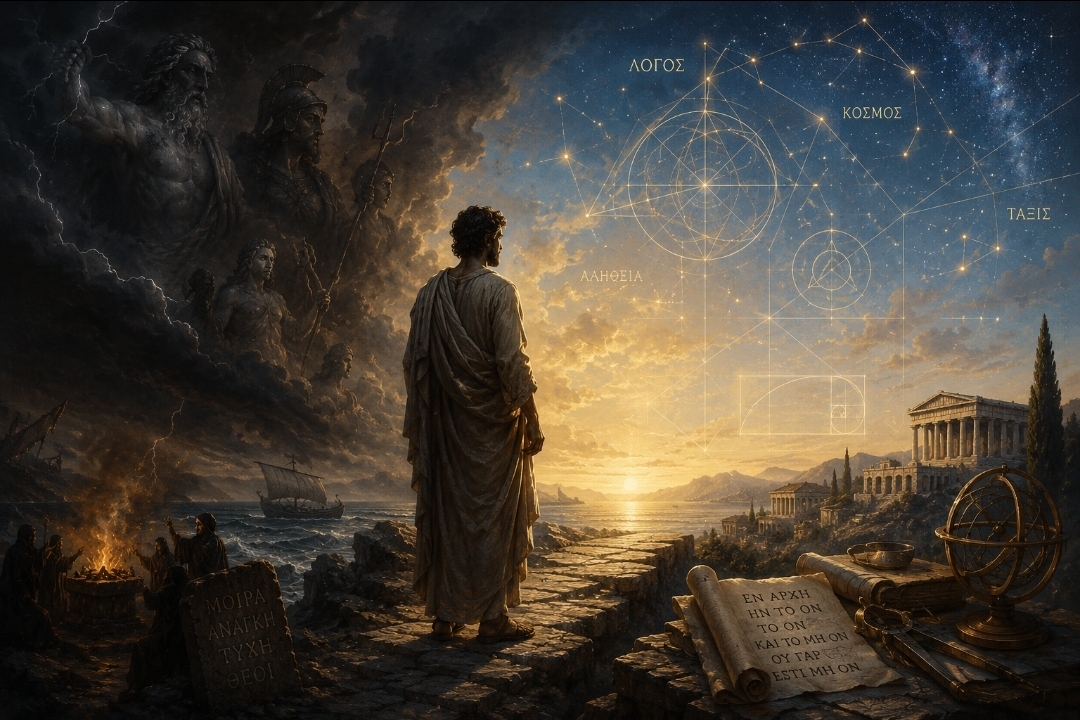
“Meaning is not something added to experience.
It emerges when perception, structure, and understanding enter into coherence.”
What Ancient Greek Philosophy Still Teaches Us About Understanding Reality
There was a moment in human history when explanation changed direction.
For centuries, the world was interpreted through story.
Storms were signs.
Thunder belonged to gods.
Fate unfolded through myth, ritual, and inheritance.
Meaning arrived already shaped — given by tradition, accepted through belonging.
And then, something shifted.
A group of thinkers began to ask a different kind of question:
not who governs the world,
but what the world is made of,
how it changes,
whether it possesses an underlying order,
and whether the human mind can understand it through reason.
This shift did not simply produce new answers.
It transformed the very structure of thought.
What began in ancient Greece was not only philosophy.
It was the first sustained attempt to understand how meaning itself emerges.
The First Break: Seeking Structure Beneath Appearance
The earliest philosophers — later called the Pre-Socratics — were not yet concerned primarily with ethics or the human soul.
They were concerned with something more fundamental:
What is the world?
Figures such as Thales, Anaximander, and Heraclitus proposed radically different answers: water, the indefinite, perpetual change.
Others, like Parmenides, denied change altogether, insisting that true reality must ultimately be unchanging.
Their conclusions were inconsistent.
Their methods were incomplete.
But their impulse was decisive.
For the first time, meaning was no longer accepted as something merely told.
It became something to be discovered through logos — through reason, structure, and inquiry.
This required a revolutionary assumption:
that beneath appearances, reality possesses an intelligible structure,
and that the human mind is capable of reaching toward it.
This assumption still governs us today.
Modern science, philosophy, and even our understanding of art continue to depend upon it:
the belief that behind the visible surface of things, coherence exists.
Socrates: Meaning as Question
With Socrates, philosophy turns inward.
The question is no longer only what the world is, but how human beings understand anything at all.
Socrates did not write.
He did not present systems or doctrines.
He asked.
Through dialogue, he exposed a profound instability:
that what people believed they understood — justice, virtue, truth, courage — often collapsed under examination.
But this was not merely destruction.
It was the beginning of a deeper realization:
Meaning does not arise from statements alone.
It emerges through the process of questioning.
To understand something is not simply to possess information about it.
It is to pass through uncertainty, contradiction, recognition, and transformation.
In this sense, meaning is not static.
It is dynamic.
It requires participation.
The unexamined life, Socrates argued, is not worth living — not because knowledge is absent, but because meaning has not yet been formed through reflection.
Plato: Meaning Beyond the Visible
Plato inherits this instability and seeks to resolve it.
If perception is unreliable,
if opinion dissolves under questioning — where can meaning be grounded?
His answer is radical.
Not in the world we immediately see.
Plato proposes that true reality lies beyond appearances, in a realm of Forms — perfect and unchanging principles such as Justice, Beauty, and the Good.
What we encounter in ordinary experience are not these realities themselves, but incomplete reflections of them.
Meaning, then, is not reducible to immediate experience.
It is approached through ascent.
The famous image of the cave illustrates this movement:
from shadow to object,
from object to light,
from light to understanding.
To know is not simply to observe.
It is to move beyond what first appears.
Meaning, in this view, is not contained within the surface of things.
It is what the surface points toward.
Aristotle: Meaning Within the World
Aristotle reverses this direction.
For him, there is no separate realm that reality must escape toward.
Form does not exist elsewhere.
It exists within things themselves.
To understand reality is not to flee the world, but to see it clearly.
Aristotle grounds meaning in structure, but a structure inseparable from lived existence:
form and matter,
potential and actualization,
cause and purpose.
Where Plato seeks certainty beyond experience, Aristotle discovers intelligibility within experience itself.
This shift is decisive.
Meaning is no longer something distant or purely transcendent.
It is something realized through engagement.
With nature.
With action.
With observation.
With life as it is actually lived.
In his ethics, this becomes even more concrete.
The good life is not an abstract perfection suspended beyond humanity.
It is something practiced, cultivated, shaped gradually through habit, judgment, and experience.
Meaning is not discovered once.
It is cultivated.
After the Collapse: Meaning as Stability
When the Greek world changed — when political structures weakened, empires expanded, and certainty dissolved — philosophy changed with it.
The central question was no longer simply: What is reality?
It became something more urgent:
How can one live within instability?
In the Hellenistic world, schools such as Stoicism and Epicureanism transformed philosophy into a form of orientation.
For the Stoics, meaning emerged through alignment with what cannot be controlled:
accepting the structure of reality while shaping one’s inner life with discipline and clarity.
For the Epicureans, meaning lay in the careful construction of a life free from fear, unnecessary desire, and inner disturbance.
Different answers, but a shared transformation.
Philosophy becomes a practice of coherence.
A way of preserving orientation when external structures fail.
What Remains
Across these movements — from the first search for substance to the cultivation of inner stability — one question persists:
Where does meaning come from?
Is it hidden beneath appearances?
Revealed through questioning?
Located beyond perception?
Embedded within reality itself?
Or constructed in response to instability?
Ancient philosophy does not offer a single answer.
What it reveals instead is something more enduring:
Meaning is not given automatically.
It must be sought, tested, approached, refined.
And that this process — whether through thought, through action, through perception, or through reflection — is inseparable from how human beings live.
Toward Meaning
What began as a break from myth became something far more significant:
the discovery that understanding is not passive.
It requires structure.
It requires attention.
It requires the willingness to move beyond what first appears.
This question did not end in antiquity.
It continues — in philosophy, in science, and in art.
Because whenever we ask not only what something is, but what it means, we enter the same problem these thinkers first revealed.
And we discover that meaning is not something added to experience.
It is something that emerges
when perception, structure, and understanding
enter into coherence.
Continue Exploring Meaning
If this question resonates with you — if meaning is not only something you think about, but something you seek to understand more precisely — this exploration continues in:
When Sound Becomes Meaning: A Philosophy of Musical Meaning and Artistic Responsibility
Where the problem of meaning is examined not only in thought, but in sound, in structure, and in the act of interpretation itself.