
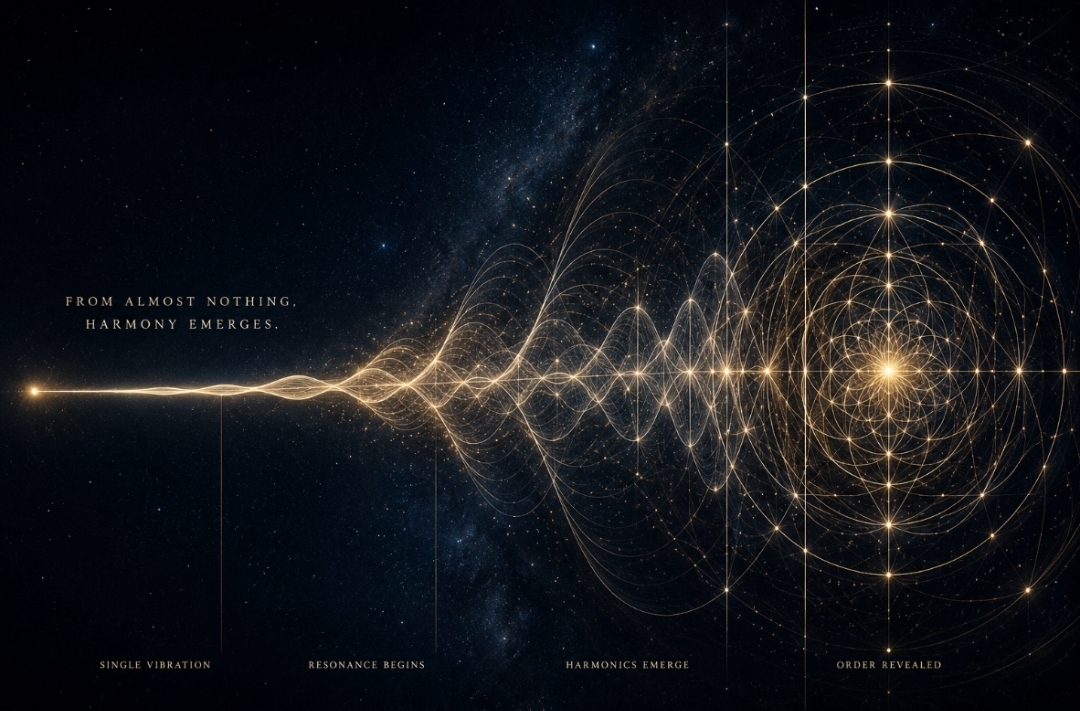
“Coherent systems naturally begin to resonate.”
Why Coherent Systems Naturally Begin to Resonate
There is a strange possibility emerging from modern physics.
According to a recent theoretical study, researchers attempting to understand the deepest structure of reality began not with strings, harmonics, or elegant mathematical symmetries, but with only a few basic assumptions about how the universe must behave under extreme conditions.
And then something unexpected happened.
Harmony appeared.
The equations naturally produced ordered resonances, vibrational relationships, and an infinite harmonic structure resembling the behavior of vibrating strings.
The researchers did not insert these patterns artificially.
They emerged on their own from the internal consistency of the system itself.
“The strings just fell out,” one of the physicists remarked.
It is a striking phrase.
Not only scientifically, but philosophically.
Because something very similar may occur in music.
Beyond Decoration
Most people think of musical meaning as something added onto sound:
emotion,
interpretation,
expression,
personality.
But perhaps this understanding is incomplete.
What if meaning does not originate from expressive decoration imposed onto music?
What if it emerges naturally when relationships inside a musical structure become sufficiently coherent?
This possibility changes everything.
Because it suggests that harmony may not simply be a stylistic invention or cultural convention, but a deeper consequence of organized resonance itself.
The Secret Hidden Inside a Vibrating String
When a violin string vibrates, it does not produce only one frequency.
It generates an entire family of hidden relationships:
overtones,
harmonics,
resonant proportions.
A single vibrating system naturally creates ordered structure.
The same phenomenon exists throughout music:
octaves,
fifths,
resonance,
tension and release,
the stability of tonal centers,
the emotional pull of cadence.
These relationships do not emerge randomly.
They arise because coherent systems begin organizing themselves into stable proportional structures.
Music, in this sense, may not merely express harmony.
It may reveal it.
Why Certain Music Feels “Inevitable”
Some performances feel constructed.
Others feel inevitable.
This difference is difficult to define technically, yet musicians recognize it immediately.
In weaker performances, one often hears:
constant effort,
surface emotion,
excessive manipulation,
continuous attempts to “show” meaning.
But in stronger performances, something else occurs.
The music seems to organize itself naturally through time.
Phrases breathe with internal necessity.
Tension resolves with architectural balance.
Nothing feels forced, yet everything feels alive.
The performer is not merely adding emotion onto notes.
They are aligning relationships.
And once those relationships become coherent enough, meaning begins to emerge almost automatically.
Very much like the harmonics emerging from a vibrating string.
Coherence Across Time
This may explain why great music depends so profoundly on memory.
A single note rarely contains meaning by itself.
Meaning emerges through relationships extending across time:
between phrases,
between harmonies,
between expectation and return,
between tension and delayed resolution.
We do not experience music as isolated moments.
We experience it as continuity.
And continuity itself depends on coherence.
If the relationships become too unstable, meaning begins to collapse.
The structure loses identity.
The listener no longer perceives direction, inevitability, or resonance.
But when coherence is preserved across time, something extraordinary happens:
The music begins to feel larger than the individual sounds that produce it.
Continue Into the Full Essay
Explore why certain structures remain meaningful even through imperfection, variation, instability, and time itself — and how resonance may connect physics, perception, and musical meaning far more deeply than we normally imagine.
• resonance and coherence across time
• inevitability in musical interpretation
• why meaning survives transformation
• hidden relationships inside perception itself